Short Answer
The safest way to use AI for interviews is before the interview: analyze the job description, generate likely questions, practice STAR answers, get feedback, and rehearse out loud.
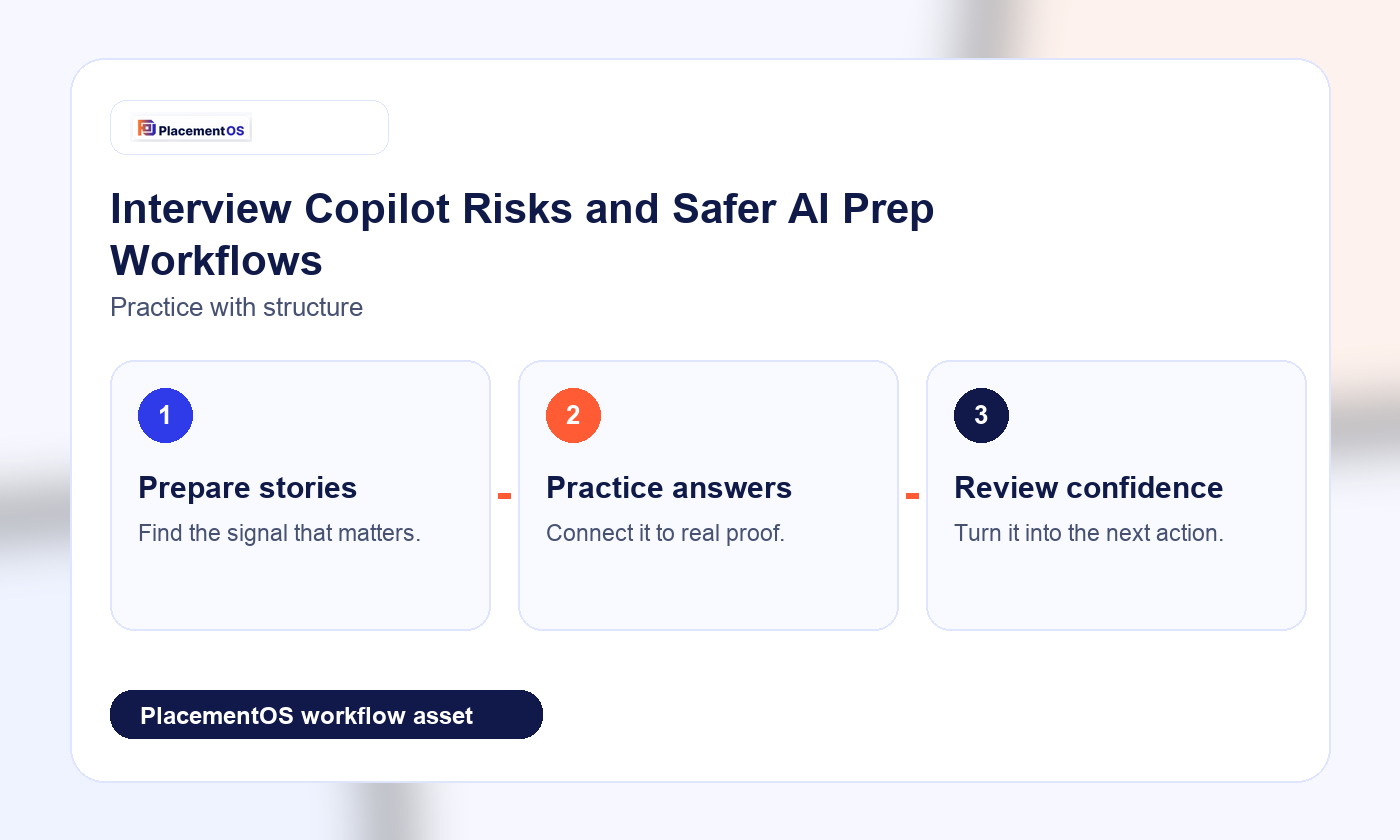
Real-time interview copilots, transcription tools, note takers, or generated answers during a live interview are riskier unless the employer explicitly allows them. They can violate interview instructions, reduce trust, expose private data, or produce answers you cannot explain under follow-up.
Safer Workflow
| Stage | Safer AI use | Risk to avoid |
|---|---|---|
| Before applying | Identify role themes and skill gaps | Inventing experience |
| Before interview | Generate likely questions and STAR prompts | Memorizing generic scripts |
| Mock practice | Ask for clarity and specificity feedback | Letting AI create the substance |
| Live interview | Follow employer rules | Hidden prompts, recordings, or generated answers |
| After interview | Draft follow-up notes | Misrepresenting what was discussed |
Candidate Checklist
Before the interview:
- Read the interview instructions.
- Prepare real examples from your background.
- Practice once without AI visible.
- Verify company facts from trusted sources.
- Remove personal or confidential data from prompts when possible.
- Ask if AI tools, note takers, or recordings are allowed when unclear.
During the interview:
- Follow the stated rules.
- Answer in your own words.
- Pause before answering if needed.
- Ask clarifying questions.
- Do not hide real-time assistance if the employer has not allowed it.
What Not To Do
Do not use hidden real-time AI answers, record or transcribe without permission, paste confidential information casually, memorize generic answers, claim experience you cannot defend, or treat AI prep as a guarantee of offers, callbacks, recruiter replies, or salary improvement.
Where PlacementOS Fits
PlacementOS should frame interview AI as one part of the broader job-search operating loop: role targeting, resume tailoring, interview preparation, follow-up, and weekly review.
The product lane is not "AI answers the interview for you." The lane is "AI helps you prepare a cleaner, more specific, more honest interview plan."
FAQ
Is using AI for interview prep cheating?
Using AI before an interview to practice, research, and improve clarity is different from using hidden AI to answer live questions. Follow employer instructions and keep the substance grounded in your real experience.
Can I use an AI note taker in an interview?
Do not assume yes. Recording, transcription, and note-taking tools can raise policy and privacy issues. Ask if unclear.
How do I practice behavioral answers with AI?
Give AI a role description and your real project notes. Ask it to help structure STAR answers, then rehearse without the tool.
How do I avoid sounding scripted?
Use real examples, speak out loud, vary phrasing, and prepare the story rather than memorizing exact sentences.
Related PlacementOS guides
Use these guides to move from comparison or preparation into a stronger weekly job-search system.
- AI job search workflow after a layoff
- Best AI job search tools for a 7-day sprint
- Tailor a resume without sounding generic
Recommended PlacementOS CTA
Before your next interview, use AI to build a practice plan: role themes, likely questions, real examples, STAR structure, and follow-up notes. Then rehearse without the tool so the live answer sounds like you.
Source Links
- Harvard Mignone Center AI interview guidance: Harvard career services guidance on AI interviews and offers
- Microsoft Copilot interview prep guidance: Microsoft Copilot interview prep guidance
- Example employer policy source: Ethena job listing with interview AI policy language
- Source refresh:
projects/placement-os/evidence/p1-second-brief-source-refresh-2026-06-11.md