Quick Answer: How do you tailor a resume to a job description without sounding generic?
To tailor a resume to a job description, do not paste the job description into your resume. Pull out the recurring skills, tools, responsibilities, and outcomes, then connect each one to a specific project, metric, customer, system, or decision you actually owned.
| Job description phrase | Weak rewrite | Proof-led rewrite |
|---|---|---|
| Cross-functional collaboration | Worked with teams | Led weekly product, design, and sales reviews to unblock launch decisions |
| SQL and dashboards | Used SQL | Built SQL dashboard that reduced manual reporting time by 6 hours per week |
| Stakeholder communication | Strong communicator | Presented roadmap tradeoffs to executives and secured launch approval |
Short Answer
To tailor a resume without sounding generic, change emphasis, order, and proof. Do not reinvent your experience.
Related PlacementOS guides
Use these guides to connect resume fit, ATS checking, and job-search workflow decisions before you apply.
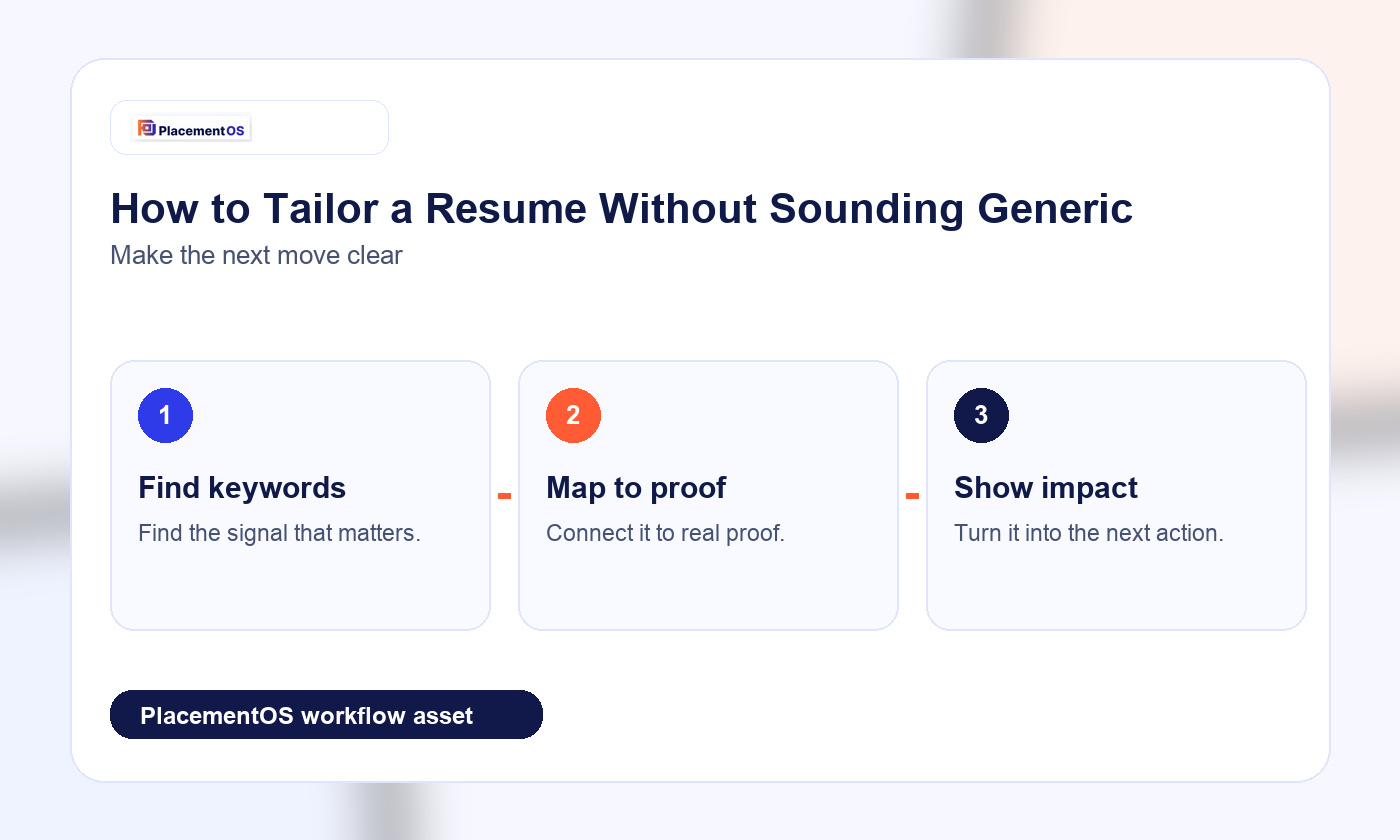
Start with one accurate base resume. Read the target job description for repeated skills, tools, responsibilities, and outcomes. Pick the 5-7 requirements that matter most. Then map each requirement to real proof from your background: projects, tools, customers, systems, metrics, decisions, teams, or deliverables.
Rewrite only the bullets that need stronger alignment. Keep the facts true enough that you can defend them in an interview without checking your notes.
The Core Rule
Tailoring is not pretending to be a different candidate. Tailoring is making the most relevant version of your real experience easier to find.
Bad tailoring adds keywords until the resume sounds like every other AI-edited resume. Good tailoring keeps the human signal: specific tools, specific scope, specific problems, specific teams, and specific outcomes.
If a line could appear on thousands of resumes, it probably needs more proof.
Step 1: Build One Source-Of-Truth Resume
Before you tailor anything, create a base resume that is complete and accurate. This is the document you trust.
It should include:
- Real job titles and dates.
- Accurate tools and systems.
- Projects you can explain.
- Metrics you can defend.
- Responsibilities you actually owned.
- Outcomes that do not exaggerate your role.
- A complete skills list that you can speak to.
The base resume is not the version you submit everywhere. It is the source material for every targeted version.
Step 2: Pull The Job Description Apart
Read the job description like a hiring team wrote it under time pressure. Some lines matter more than others.
Look for repeated skills, required tools, role level, core responsibilities, business outcomes, customer type, industry context, and nice-to-have signals. Then make a short priority list. Do not tailor for every word. Tailor for the role's center of gravity.
Step 3: Map Requirements To Real Proof
Use a simple table before editing:
| Job requirement | Real proof from your background | Resume action |
|---|---|---|
| Tool or platform | Project, role, dashboard, workflow, or system where you used it | Name it in the relevant bullet |
| Stakeholder work | Customer, executive, manager, field team, or partner interaction | Replace vague "stakeholders" with the audience |
| Process improvement | Before/after workflow, cycle time, quality, cost, or handoff change | Add context and result |
| Analysis | Dataset, report, model, query, or decision supported | Name the analysis and business use |
| Leadership | Team size, scope, decision, training, or ownership | Show the behavior in action |
This step prevents generic AI rewrites. You are feeding the resume real material before asking for better wording.
Step 4: Rewrite Only What Needs Alignment
You do not need a brand-new resume for every job. Usually, you need targeted edits:
- Move the most relevant experience higher.
- Rename a section to match the role's language when accurate.
- Rewrite bullets that are true but too vague.
- Add a missing tool only if you actually used it.
- Remove less relevant bullets to make space.
- Update the summary for the target role.
Good tailoring often means fewer changes, not more.
Weak Bullet To Strong Bullet Examples
| Weak signal | Better direction |
|---|---|
| Helped improve operations | Name the process, team, system, and improvement |
| Worked with stakeholders | Name the stakeholder type and what decision or workflow you supported |
| Used data to make decisions | Name the dataset, tool, analysis, and decision |
| Responsible for projects | Name the project scope, timeline, and outcome |
| Strong communicator | Show the audience, deliverable, and result |
The stronger version does not need to be longer. It needs to carry more evidence.
How To Use AI Without Losing Your Voice
AI can help you edit. It should not become the source of truth.
Useful prompts:
- "Keep the facts exactly the same. Make this bullet clearer and more specific."
- "Identify which job-description requirements are not clearly represented in my resume. Do not rewrite yet."
- "Rewrite this bullet in three styles: concise, metrics-focused, and operations-focused. Do not add new facts."
- "Flag any phrase that sounds generic or overused."
- "Which bullets would be hard to defend in an interview?"
Avoid prompts that ask AI to invent achievements, metrics, seniority, tools, or responsibilities.
The Interview Defense Test
For every tailored bullet, ask:
- Can I explain the project in 60 seconds?
- Can I name the tool, system, or method?
- Can I explain my role versus the team's role?
- Can I describe the before and after?
- Can I answer follow-up questions without inventing details?
- Would a former manager recognize this as true?
If the answer is no, revise the bullet until it is accurate.
What Not To Do
Do not keyword-stuff the resume, add tools you have not used, inflate metrics, claim ownership for work you only observed, treat an ATS score as a hiring prediction, or send the same generic AI summary to every role.
Resume tailoring is part of a job-search system, not a substitute for judgment.
Where PlacementOS Fits
PlacementOS should be positioned as the workflow layer around resume tailoring. The job seeker does not only need a better bullet. They need a system for target roles, resume versions, application status, follow-up dates, interview prep, weekly review, and signal quality.
That is the PlacementOS lane: turn resume edits into a cleaner job-search operating loop.
FAQ
How much should I tailor my resume for each job?
Tailor the summary, skills order, and the bullets most relevant to the role. You do not need to rewrite the whole resume unless the target role is substantially different.
Should I use the exact keywords from the job description?
Use exact terms when they are accurate to your experience. Do not force keywords into awkward sentences or add tools you cannot defend.
Can AI tailor my resume for me?
AI can help identify gaps, improve clarity, and suggest edits. You still need to verify every fact, preserve your voice, and make sure the resume reflects real experience.
How do I avoid sounding generic?
Use specific nouns: tools, systems, teams, customers, deliverables, metrics, and decisions. Replace broad claims with proof.
Is a higher resume match score always better?
No. Match scores can be useful guidance, but they do not guarantee interviews or hiring outcomes. A readable, truthful, specific resume is more important than chasing a score.
Related PlacementOS guides
Use these guides to move from comparison or preparation into a stronger weekly job-search system.
- Best AI resume tailoring tools
- Jobscan alternative for an AI job search system
- Compare Teal, Jobscan, Careerflow, and PlacementOS
Recommended PlacementOS CTA
If your resume sounds generic after AI edits, rebuild the workflow. Start with your real experience, map it to the role, tailor only what needs emphasis, and track which version you used for each application.
Source Links
- Bentley University AI job-search guidance: Bentley University guidance on AI in the job search
- WGU AI resources: WGU career services AI job search resources
- Jobscan official site: Jobscan ATS resume scanner
- Source refresh:
projects/placement-os/evidence/p1-brief-source-refresh-2026-06-11.md