A resume score evaluates the document; a job match score evaluates fit against a specific role. Both are useful diagnostics, but neither proves you will get an interview. The real goal is accurate, readable proof aligned to the job.
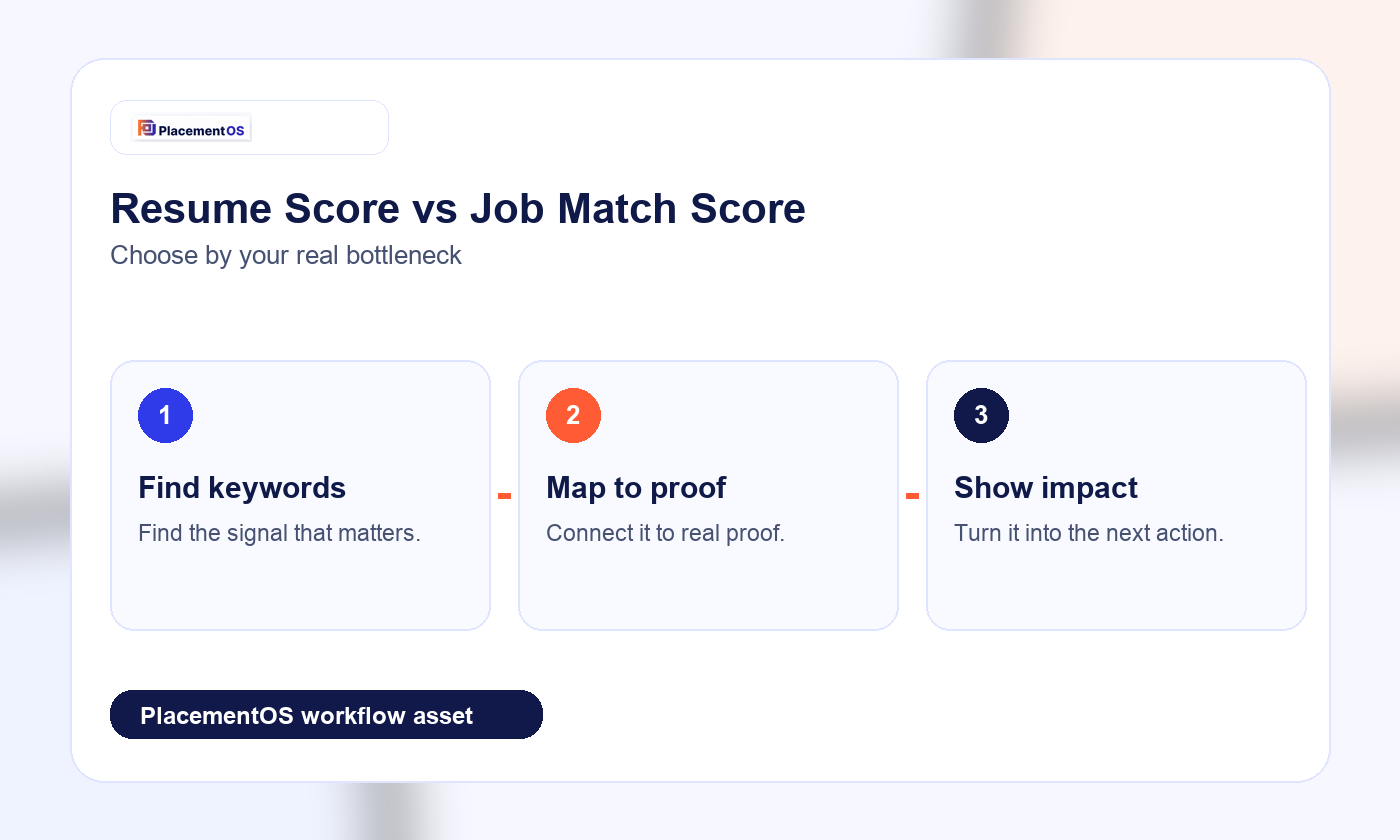
Quick Answer: Is a resume score checker enough?
A resume score checker is useful as a diagnostic, but it is not enough by itself. A stronger workflow combines the resume score with a resume match score or job match score, then turns each gap into a truthful resume edit, a stronger proof point, or a decision to skip a low-fit role.
| Signal | What it means | Best next action |
|---|---|---|
| Low keyword match | The resume may not mirror role language | Add real projects, tools, and outcomes that prove the term |
| High score but weak fit | The resume is clean but role proof is thin | Target a better-fit job or rewrite bullets around impact |
| Good match score | The role is worth a tailored application | Apply with a custom summary and tracked follow-up |
Quick comparison
| Question | Best answer | PlacementOS angle |
|---|---|---|
| Primary problem | resume score vs job match score | Connect the point solution to weekly execution. |
| Risk to avoid | Unreviewed automation, keyword stuffing, or scattered tracking. | Keep human review and outcome review in the loop. |
| Best next action | Choose the tool by bottleneck, not hype. | Target, tailor, apply, follow up, and learn weekly. |
The difference
A resume score usually checks structure, formatting, sections, bullet clarity, and sometimes overall ATS readiness. A job match score compares the resume to a particular job description, including skills, keywords, titles, and requirements.
Why scores can mislead
Scores are helpful only if they lead to better decisions. Chasing a higher score can create keyword stuffing, awkward bullets, inflated claims, or generic language. The score should point to a gap; the candidate still has to decide whether the gap is real and fixable.
How competitors frame the category
Jobscan emphasizes match-rate reports and missing skills. Rezi emphasizes AI keyword targeting and ATS compatibility. Teal emphasizes match scoring and job tracking inside a broader job-search workflow. PlacementOS should connect the score to role choice, tailoring, tracking, and weekly review.
A safer scoring workflow
Scan the resume against the job description, group missing terms into true experience, adjacent experience, and no experience, then edit only the first two groups. Keep bullets specific. If a must-have skill is missing entirely, the right action may be skipping the role, not forcing the keyword.
When to stop optimizing
Stop when the resume clearly shows fit, uses accurate role language, stays readable, and preserves your real story. A slightly lower score with honest, specific proof is better than a high score that collapses under recruiter review.
What to do after scoring
Do not leave the score inside the resume tool. Save the role, the resume version, the missing-skill notes, and the reason you applied inside the job-search tracker. If the application gets no response, that history helps you decide whether the issue was role fit, proof quality, timing, or volume.
Example scoring review
If a posting asks for SQL, dashboarding, and stakeholder communication, do not paste those terms into the resume blindly. Find the real project where you used SQL, name the dashboard outcome, and show who used the work. The score becomes useful only when it pushes proof closer to the job.
Best fit and poor fit
Resume scoring is a strong fit when the candidate needs a diagnostic before tailoring. It is a poor fit when the candidate wants the score to make the decision. A role can score well and still be a bad target if the work, seniority, location, or compensation do not fit.
Decision rule
Choose the tool only after naming the bottleneck. If the bottleneck is speed, improve the repetitive steps. If the bottleneck is fit, improve targeting and proof. If the bottleneck is follow-up, improve the tracker. If the bottleneck is uncertainty, use a weekly review before adding more applications.
This is the PlacementOS rule for the whole cluster: tools are useful when they make the next action clearer. They are risky when they create more activity without better decisions, stronger evidence, or cleaner follow-through.
Related PlacementOS guides
- Best AI resume tailoring tools
- How to tailor a resume without sounding generic
- Jobscan alternative for AI job search
FAQ
What is a good resume score?
A good resume score is one that reveals useful improvement opportunities. It should not be treated as a promise of passing an ATS or getting an interview.
Is job match score more important than resume score?
For a specific application, job match is usually more useful because it compares your resume to that role. Resume score is broader document hygiene.
Should I add every missing keyword?
No. Add only keywords that reflect real experience, adjacent skills, or accurate wording. Do not add claims you cannot support.
Sources
- Jobscan official site
- Rezi AI keyword targeting
- Rezi official AI info
- Teal resume builder
- Jobscan auto apply
Related PlacementOS guides
Use these guides to connect resume fit, ATS checking, and job-search workflow decisions before you apply.
Use PlacementOS when you want the whole search organized into a weekly operating loop instead of another disconnected tool decision.