Quick answer: The best AI resume checker tool depends on your bottleneck. If you need keyword diagnostics, use an ATS resume checker. If you need writing feedback, use a resume score checker. If you need to decide which jobs to pursue and how to tailor, use a workflow layer like PlacementOS.
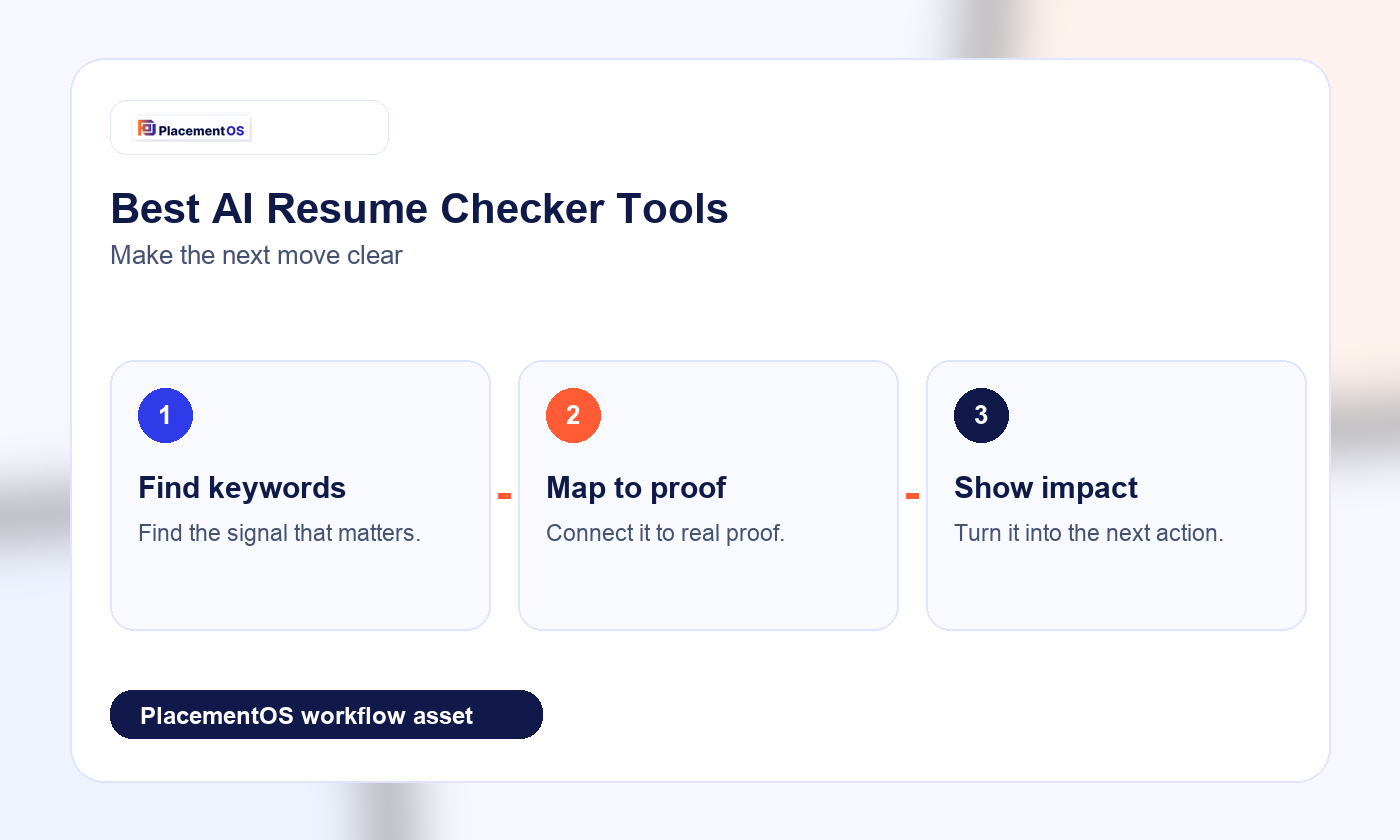
Resume checkers are useful, but they are easy to misuse. A score can make a weak application feel objective. A keyword report can tempt you to stuff terms into bullets. The right tool should help you improve the resume while keeping every claim truthful.
How to compare AI resume checker tools
| Tool need | What to look for | Red flag |
|---|---|---|
| ATS resume checker | Clear keyword gaps and formatting guidance | Promises that a score guarantees interviews |
| Resume score checker | Specific feedback on clarity, impact, and structure | Generic advice that could fit any resume |
| Resume tailoring | Job-description matching with proof review | Rewrites that invent experience |
| Job-search workflow | Fit scoring, tracking, follow-ups, and interview prep | Only optimizes documents, not decisions |
Best categories of tools
1. ATS resume checker tools
Use these when the job description has specific skills, systems, certifications, or role language that your resume may not reflect. The output should be treated as a checklist, not as a command to copy every keyword.
2. Resume score checker tools
Use these when the resume is hard to scan, vague, too long, too task-heavy, or missing measurable outcomes. Strong feedback should point to concrete improvements.
3. AI resume tailoring tools
Use these when you already know the role is worth applying to and need help making relevant proof easier to see. Good tailoring preserves your voice and your facts.
4. PlacementOS-style workflow tools
Use this layer when the question is bigger than the resume. Which jobs should you apply to this week? Which roles need tailoring? Which follow-ups are due? Which interview stories need work?
Quality-control checklist
- Every keyword should connect to real experience.
- Every rewritten bullet should be defensible in an interview.
- Every application should have a tracked next action.
- Every high-effort tailoring session should target a role with strong fit.
Recommended PlacementOS path
Start with resume score vs job match score. Then compare Jobscan vs Resume Worded vs PlacementOS. If the role is worth pursuing, use the proof-led resume tailoring workflow.
Related PlacementOS guides
Use these guides to connect ATS checks, resume keywords, job match decisions, and proof-led tailoring before you apply.