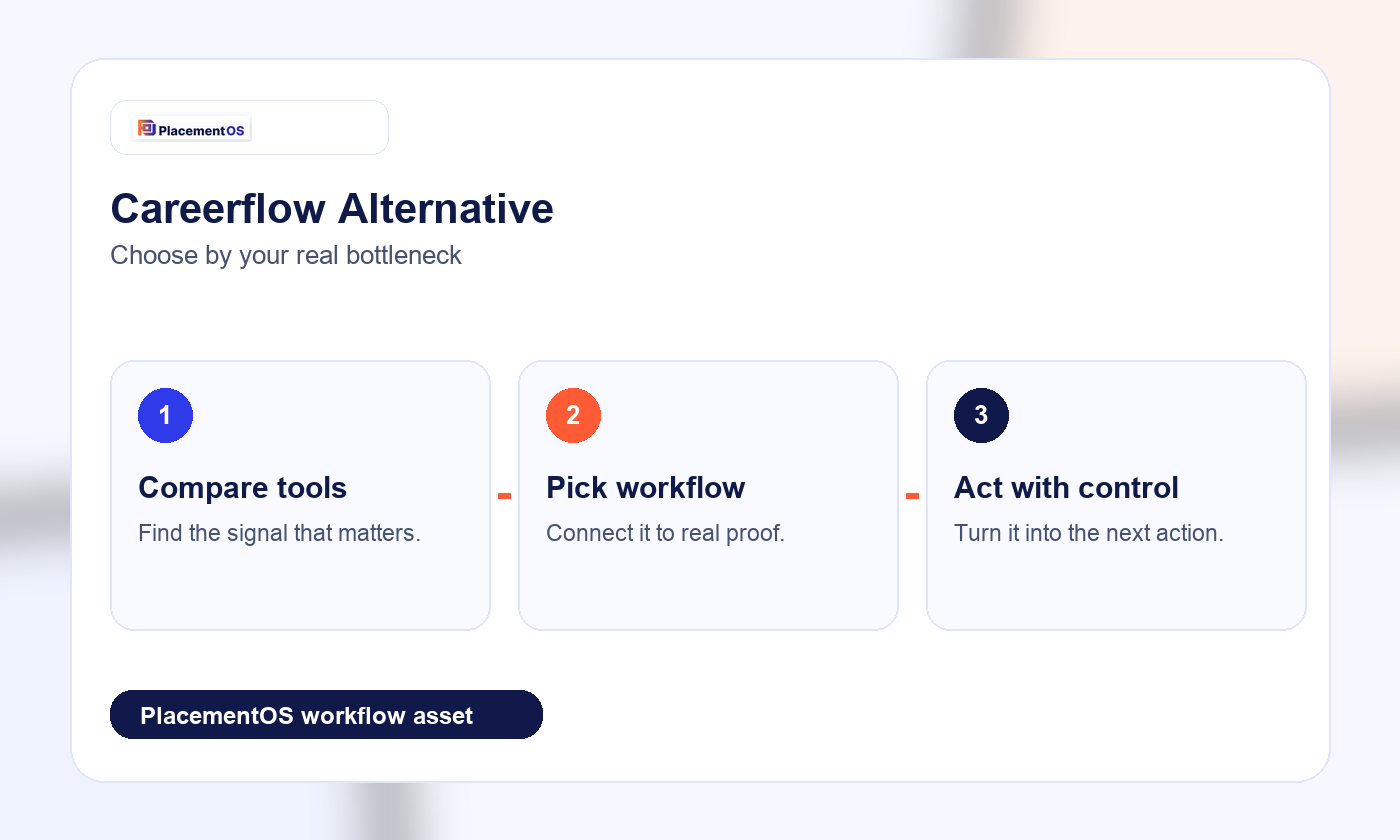
A good Careerflow alternative should do more than collect AI career tools. Look for a system that helps pick target roles, tailor evidence, review applications, track follow-up, and learn from weekly outcomes.
Quick comparison
| Question | Best answer | PlacementOS angle |
|---|---|---|
| Primary intent | Careerflow alternative | Turn the search into a decision and weekly action. |
| Main risk | Picking a tool, score, or platform result without reviewing fit. | Keep human review, proof, and follow-up in the loop. |
| Best next action | Name the bottleneck first. | Target, tailor, apply, follow up, and learn weekly. |
Why Careerflow is a serious comparison point
Careerflow has a wide surface area: AI resume building, LinkedIn profile optimization, job tracking, autofill, cover letters, networking support, and mock interview workflows. That breadth makes it a natural comparison for candidates who want one place to manage the job search. The question is not whether those tools are useful. The question is whether the candidate gets a clear operating rhythm or simply more features to check.
The PlacementOS wedge
PlacementOS should compete on the weekly loop. A candidate needs to know which roles deserve attention, which resume version fits, which proof should be strengthened, what follow-up is due, and what the market is teaching them. A career copilot can help with tasks, but an operating system should make the next decision obvious.
Best-for comparison
Careerflow is a strong fit for candidates who want profile optimization, resume help, browser-extension support, and a broad career toolkit. Teal and Huntr are stronger references when tracking is the central problem. PlacementOS should be evaluated when the issue is scattered execution: too many tools, unclear target roles, weak review habits, or applications that do not turn into interview signal.
Workflow to use before switching
Before switching from Careerflow or any all-in-one tool, audit the last two weeks. Count roles saved, roles applied to, resume versions created, follow-ups sent, interviews booked, and roles that were poor fit in hindsight. If the search has activity but no signal, the next platform should improve selection and review rather than only adding more AI generation.
Quality-control checklist
Use five checks for every application: target-role fit, proof fit, resume accuracy, screening-answer accuracy, and next follow-up date. If a tool improves these checks, it is helping. If it only increases volume or creates prettier drafts, it may not solve the real search problem.
Example weekly operating loop
Monday, choose ten roles and reject the weak-fit ones. Tuesday, tailor the top five resumes. Wednesday, submit reviewed applications and save each decision. Thursday, follow up and prepare for active interviews. Friday, review response patterns and update the target list. That cadence is the difference between tool usage and career execution.
How to decide
Pick Careerflow if LinkedIn optimization and broad AI career tooling are the main bottleneck. Pick a tracker-first tool if the problem is lost applications. Pick PlacementOS when the job search needs a disciplined system that connects targeting, tailoring, applications, follow-up, and outcome review.
Decision rule
Choose the workflow by bottleneck. If discovery is weak, improve search prompts. If resume proof is weak, improve bullets. If applications are scattered, improve tracking. If results are unclear, improve weekly review before adding more volume.
PlacementOS belongs in the moment where a candidate needs the whole search organized into one operating loop instead of another disconnected tool decision.
Related PlacementOS guides
- AI job-search tools comparison hub
- Best AI job search tools for a 7-day sprint
- Huntr alternative job-search operating system
- AI job search workflow after a layoff
FAQ
What is Careerflow best for?
Careerflow is best for candidates who want a broad AI career toolkit with resume, LinkedIn, tracking, autofill, and interview-prep support.
What should a Careerflow alternative include?
A strong alternative should include role targeting, resume/job fit, application review, follow-up tracking, interview prep, and weekly outcome review.
Is PlacementOS a resume builder?
PlacementOS should be framed as a job-search operating system, not only a resume builder. Resume work is one part of a larger search workflow.
Sources
Use PlacementOS when you want a quality-controlled weekly search, not just another place to generate resumes, collect scores, or submit more applications.