Quick answer: A weekly job search plan with AI should help you choose better roles, tailor the right resumes, schedule follow-ups, and prepare interview stories. The goal is not to apply everywhere faster. The goal is to run a repeatable weekly loop that improves application quality and learning.
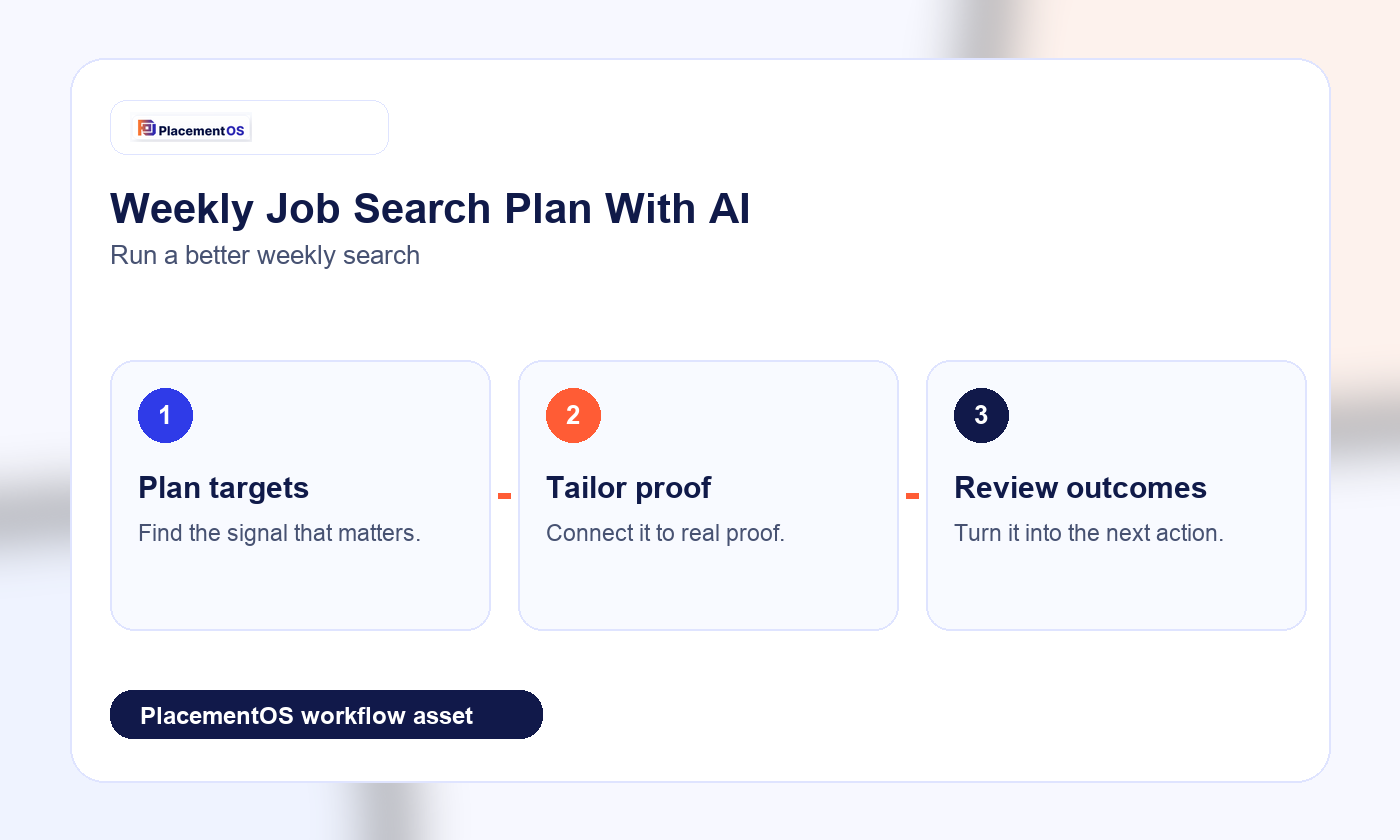
Job searches get messy when every day starts from scratch. AI helps most when it creates structure: what roles to target, what proof to strengthen, what to send, what to follow up on, and what to learn from responses.
The weekly plan
| Day | Focus | Output |
|---|---|---|
| Monday | Target roles | Shortlist 10-15 jobs by fit and priority |
| Tuesday | Resume tailoring | Build 2-3 resume versions around real proof |
| Wednesday | Applications | Send high-fit applications with tracked resume versions |
| Thursday | Follow-ups | Follow up on warm or stale opportunities |
| Friday | Interview prep and review | Practice stories and review what produced responses |
How AI should help
- Summarize job descriptions into requirements.
- Compare role fit against your real experience.
- Suggest resume proof points, not fake claims.
- Draft follow-up messages that stay concise and specific.
- Identify stale applications and next actions.
What to avoid
Do not let AI turn the week into a volume contest. Avoid generic resumes, mass-applied cover letters, and follow-ups that sound automated. If the workflow creates more noise than signal, slow it down and prioritize better-fit roles.
PlacementOS weekly operating loop
- Choose targets. Pick roles where your proof is strongest.
- Tailor smartly. Use proof-led resume tailoring instead of keyword stuffing.
- Track every application. Use a job application tracker that records resume version and follow-up date.
- Review outcomes. Look at replies, interviews, and dead zones.
- Adjust next week. Double down on roles and messages that produce traction.
If you are rebuilding after a layoff, pair this plan with the AI job search workflow after a layoff.