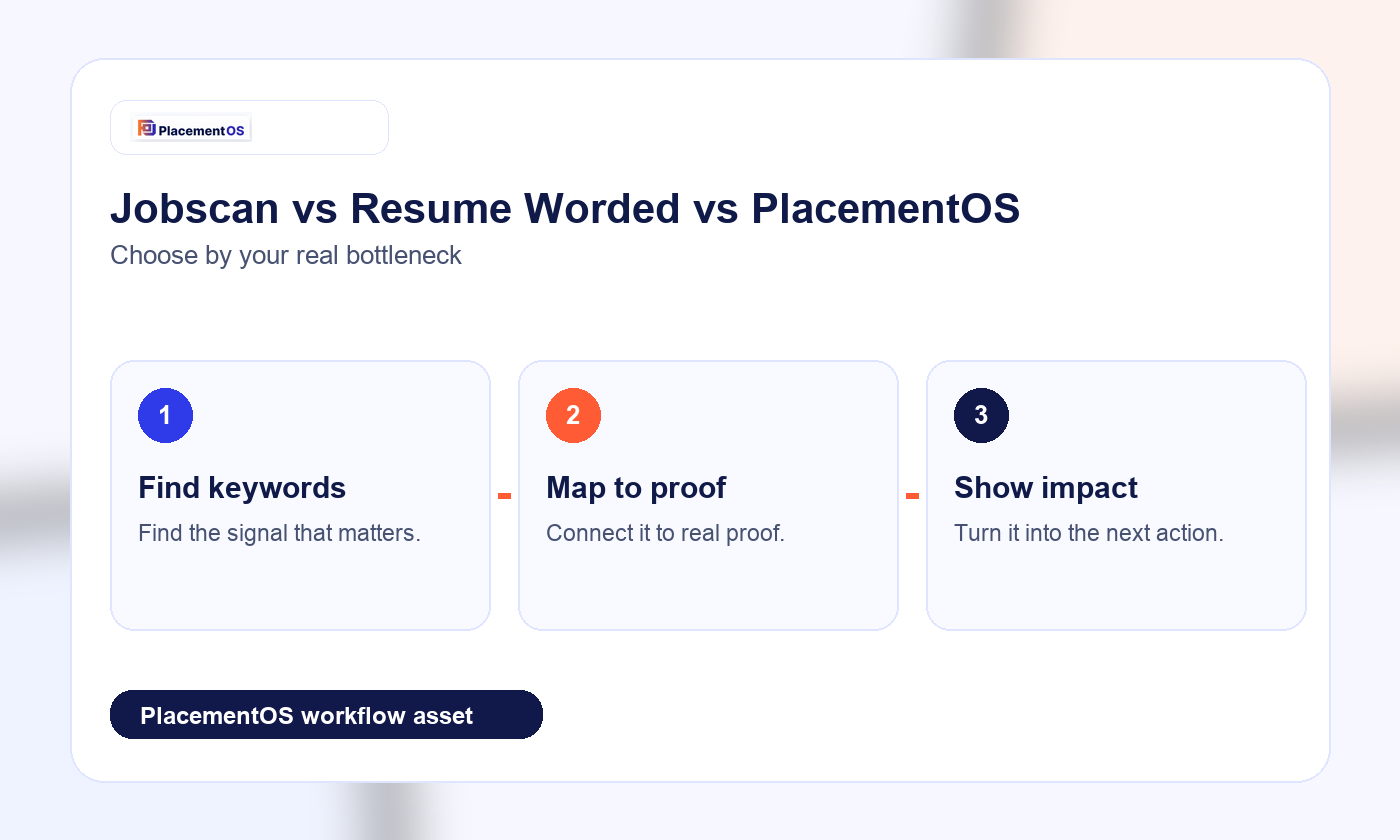
For Jobscan vs Resume Worded, Jobscan is useful when you want to compare a resume against a specific job description. Resume Worded is useful when you want resume scoring and wording feedback. PlacementOS fits when you need to connect those checks to role-fit decisions, proof rewrites, application priorities, and a repeatable job-search workflow.
Quick comparison
| Need | First option | Second option | PlacementOS angle |
|---|---|---|---|
| ATS/job-description match | Core strength | Available through resume scan/feedback lens | One input into job-match decisions |
| Resume score | Match-rate and checklist style | Core scoring and feedback angle | Treated as a diagnostic, not the final goal |
| Proof rewriting | Checklist-driven | Feedback-driven | Role-fit and evidence-driven |
| Best user | ATS checker shopper | Resume feedback shopper | Candidate optimizing fit and execution |
Quick recommendation
Use Jobscan when your main question is whether a resume matches a specific job description. Use Resume Worded when your main question is whether the resume reads clearly and meets common screening expectations. Use PlacementOS when the score is only the start and you need to decide which roles deserve applications, which bullets need proof, and what action comes next.
ATS score versus resume score versus job match
An ATS match score can help expose missing keywords, but it should not become the goal. A resume score can flag weak bullets, structure, or wording, but it may not know your target role deeply enough. A job-match workflow asks a different question: does this candidate have credible evidence for this role, and can that evidence be expressed clearly?
Keyword coverage without keyword stuffing
A checker can identify terms that appear in the job description. The candidate still has to decide which terms are truthful. If a posting asks for Salesforce, SQL, stakeholder management, or forecasting, the resume should show proof only when the candidate can defend it. PlacementOS should turn missing terms into decisions: rewrite, soften, learn, or skip the role.
What to do after the score
The most important step after any checker result is not another scan. It is rewriting one or two high-impact bullets, tightening the summary, validating the skills section, and saving a version for that role family. Then the candidate should track whether that version produces responses. Scores become useful when they change behavior.
When Jobscan or Resume Worded may be enough
If the candidate already knows which roles fit and only needs a diagnostic pass, a checker may be enough. If the resume has structural issues, a feedback-first product can help. PlacementOS becomes more useful when multiple roles look plausible, the resume proof is uneven, or the candidate needs a repeatable weekly system.
Where PlacementOS fits
PlacementOS should be positioned as a workflow layer around checkers, not a claim that checkers are useless. The useful sequence is: inspect match, identify missing proof, rewrite truthfully, choose better-fit roles, apply with quality, and learn from response data. That is broader than a score.
Decision rule
Use Jobscan or Resume Worded when you need a focused resume diagnostic. Use PlacementOS when you need the diagnostic connected to job targeting, proof rewriting, follow-up, and weekly execution. Do not optimize for a score that makes the resume less truthful or less readable.
Related PlacementOS guides
- Jobscan alternative: AI job search
- Resume score vs job match score
- Best AI resume tailoring tools
- Tailor a resume without sounding generic
FAQ
Is Jobscan better than Resume Worded?
Jobscan is usually more directly tied to resume-to-job-description matching. Resume Worded is more focused on resume scanning and feedback. The better option depends on whether you need job-specific matching or broader resume feedback.
Is a resume score enough to get interviews?
No. A resume score is only a diagnostic. Recruiter response also depends on role fit, proof quality, market timing, application volume, referrals, and whether the resume tells a credible story.
What should I do after an ATS checker result?
Rewrite the most important bullets, remove unsupported keywords, tighten the skills section, save a role-specific version, and track whether the version improves response quality.
Sources
- Jobscan ATS resume checker
- Jobscan targeted resume checker
- Resume Worded resume scanner
- Resume Worded targeted resume resource
Use PlacementOS when the job search needs to become a repeatable workflow: choose better roles, prove fit truthfully, apply with quality, follow up, and learn from each week.