Strong software engineer resume keywords connect technical skills to shipped proof: languages, frameworks, APIs, cloud, databases, testing, CI/CD, observability, architecture, performance, security, and collaboration. List tools carefully, then prove them through systems, features, reliability improvements, or measurable engineering impact.
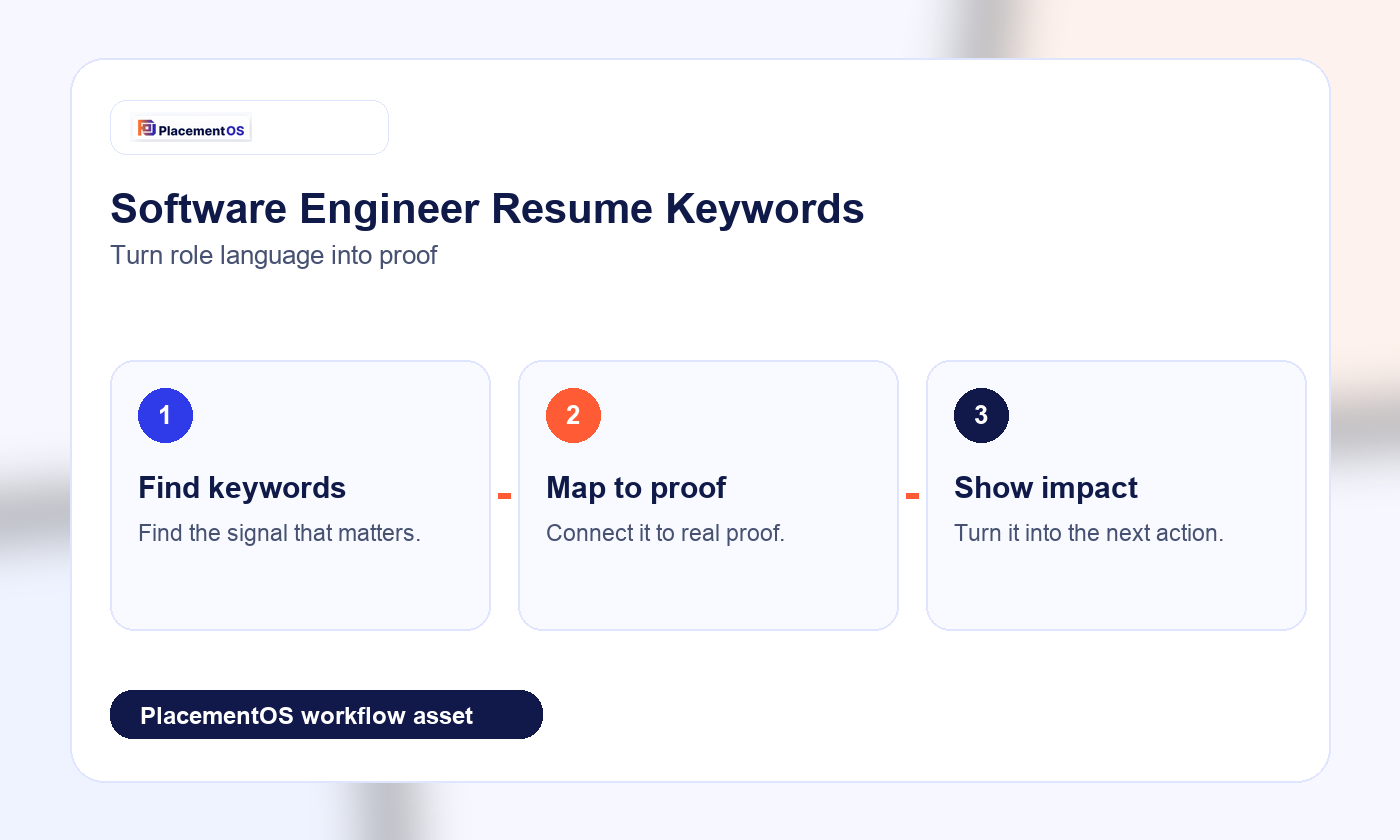
Keyword-to-proof map
| Question | Best answer | PlacementOS angle |
|---|---|---|
| Primary intent | software engineer resume keywords | Map each keyword to truthful role proof. |
| Main risk | Stuffing terms without interview-ready evidence. | Separate proven, adjacent, and absent skills before editing. |
| Best next action | Rewrite one bullet per must-have requirement. | Save the tailored version and track outcomes by role type. |
Technical keywords need ownership proof
Software engineering postings often include long lists of languages, frameworks, cloud services, databases, tools, and engineering practices. A resume can pass a quick scan only if the keywords are visible, but it earns trust when those keywords connect to ownership: shipped features, maintained systems, tests, incidents, migrations, performance wins, or cross-functional collaboration.
Keyword groups to separate
Separate languages, frameworks, systems, and practices. Languages include Python, JavaScript, TypeScript, Java, Go, C++, Ruby, or SQL. Frameworks include React, Node, Django, Rails, Spring, or Next.js. Systems include APIs, databases, queues, cloud infrastructure, and observability. Practices include testing, code review, CI/CD, security, performance, and incident response.
Keyword-to-proof table
React should connect to shipped interfaces, performance, accessibility, or design-system work. API should connect to endpoints, contracts, latency, reliability, or integrations. Cloud should connect to deployed services, infrastructure ownership, cost, reliability, or scaling. Testing should connect to coverage, regression reduction, release confidence, or quality gates.
How to tailor safely
Do not list every tool you have briefly touched as a core skill. Mark each keyword as core, working, familiar, or absent. Core skills can go into bullets and skills. Working skills can appear when honest. Familiar skills should be de-emphasized. Absent skills should not be claimed. This prevents interviews from exposing inflated keyword matching.
Example bullet rewrite
Weak bullet: used React, Node, and AWS. Stronger bullet: built a React onboarding flow backed by Node APIs, added integration tests, and deployed through AWS-backed CI/CD, reducing manual support handoffs during customer setup. The stronger bullet gives technical keywords context and impact.
How PlacementOS should fit
PlacementOS can help engineers compare job requirements with actual project proof. It can identify missing keywords, separate core skills from weak claims, suggest stronger bullets, save role-specific versions, and track response patterns by stack or role type. The result is cleaner targeting, not a stuffed skills list.
Decision rule
Use software engineering keywords when they reflect work you can explain in code, architecture, tradeoff, or incident detail. Prioritize the stack and practices the job clearly requires, then prove them through shipped work and engineering outcomes.
Decision rule
Use keywords when they clarify real experience. Skip or soften keywords that are not supported by projects, tools, stakeholders, outcomes, or interview-ready stories. The best resume is not the one with the most terms; it is the one where each term speeds up trust.
PlacementOS belongs where candidates need to turn a job description into a truthful match plan, a tailored resume version, and a weekly feedback loop.
Related PlacementOS guides
- Data analyst resume keywords
- Tailor a resume without sounding generic
- Best AI resume tailoring tools
- Resume score vs job match score
FAQ
What keywords should a software engineer resume include?
Common groups include programming languages, frameworks, APIs, databases, cloud, testing, CI/CD, observability, architecture, performance, security, and collaboration.
Should I list every programming language I know?
No. Prioritize languages and frameworks you can discuss through real projects, production work, coursework, or credible portfolio evidence.
Where should technical keywords go?
Put core stack keywords in both the skills section and experience bullets. Experience bullets should show what you built, improved, tested, scaled, or shipped.
Sources
Use PlacementOS when role-specific resume keywords need to become proof, tracking, follow-up, and search learning instead of a one-time edit.