For Careerflow vs Teal, Careerflow is strongest when the search starts with profile optimization and broad AI career-copilot tools. Teal is strongest when the search needs a tracker and resume workspace. PlacementOS fits candidates who want a structured operating loop: role fit, resume proof, application quality, and weekly review in one system.
Quick Answer: AI career copilot or job-search operating system?
An AI career copilot can be helpful for ideas, profile feedback, and broad suggestions. PlacementOS should target candidates who need those suggestions converted into a measurable job-search sprint: target roles, resume match score, tailored applications, follow-ups, and interview preparation.
| Candidate question | Copilot answer | Operating-system answer |
|---|---|---|
| What should I improve? | General recommendations | Ranked tasks for this week |
| Which jobs should I apply to? | Search suggestions | Fit-based shortlist |
| How do I tailor? | Draft edits | Keyword-to-proof workflow |
Quick comparison
| Need | First option | Second option | PlacementOS angle |
|---|---|---|---|
| LinkedIn/profile support | Strong LinkedIn and profile angle | Limited compared with profile-first tools | Supports positioning, but not profile-only |
| Job tracking | Part of broader career platform | Core workflow | Connected to role fit and action planning |
| Resume fit | Resume and job-search tooling | Resume workspace and scoring | Proof mapping and job-match workflow |
| Best user | Profile-heavy candidate | Organized tracker/resume user | Candidate needing weekly execution discipline |
Quick recommendation by search stage
Choose Careerflow when LinkedIn/profile optimization is the lead problem. Choose Teal when you already know the roles you want and need a cleaner tracker and resume workspace. Consider PlacementOS when you have tools but still lack a search operating rhythm: target selection, proof mapping, application quality control, and a weekly review cadence.
Profile-first versus tracker-first versus workflow-first
Careerflow's public positioning emphasizes AI career tools, LinkedIn optimization, resumes, and application tracking. Teal's positioning emphasizes resume creation, job tracking, and job-search organization. PlacementOS should occupy the workflow-first lane: it should help a candidate decide what to do next, not only where to store information.
LinkedIn and profile optimization
A profile-first workflow can be valuable for candidates who rely on inbound recruiter discovery or networking. The limitation is that profile improvement alone does not decide which job descriptions deserve custom resumes. A strong search still needs a role-fit filter, proof inventory, and application cadence.
Resume and job-fit analysis
Resume tools can identify gaps, but the candidate still needs judgment. If a posting asks for a skill the candidate cannot support, the answer is not to stuff the term into the resume. PlacementOS should separate truthful proof from adjacent experience and then recommend targeted bullets, role deprioritization, or a learning gap.
Application quality control
Speed tools can create a false sense of progress when a candidate sends many weak applications. A quality workflow asks whether the role matches the candidate's strongest evidence, whether the resume version reflects the posting, whether the application has a follow-up path, and whether similar roles are producing responses.
Which tool should you start with?
Related PlacementOS guides
Use these guides to connect resume fit, ATS checking, and job-search workflow decisions before you apply.
- Teal vs Jobscan vs Careerflow vs PlacementOS
- best AI job search tools
- resume score vs job match score
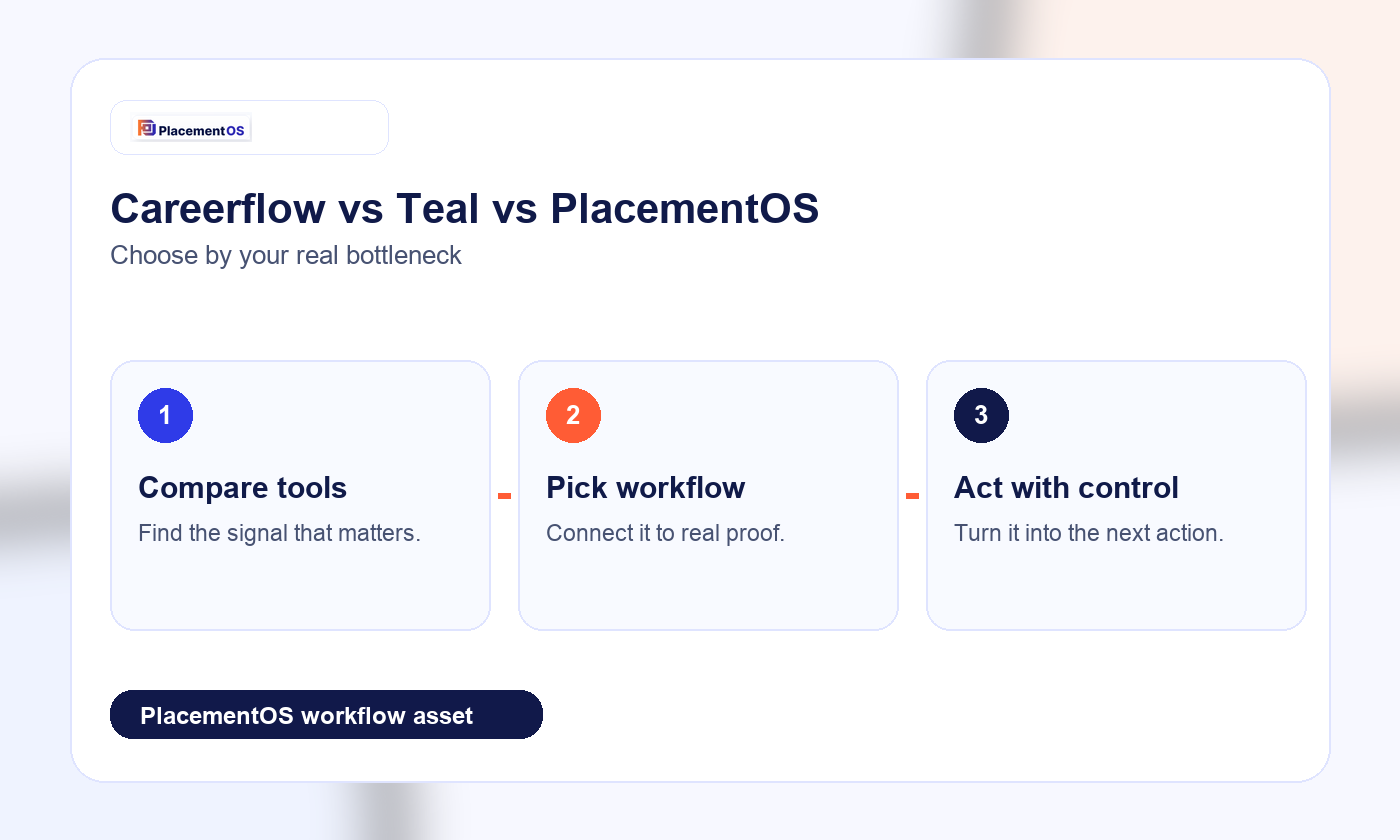
Start with the tool that matches the current bottleneck. If no one is finding you, improve profile positioning. If the search is disorganized, add a tracker. If the search is organized but not converting, move to a workflow that tests fit, proof, and weekly learning.
Where PlacementOS should fit
PlacementOS should be framed as the system candidates use after they realize that job search is not a single resume score or one tracker column. It is a loop: choose roles, prove fit, apply carefully, follow up, learn from responses, and repeat. That loop is the durable positioning.
Decision rule
Use Careerflow when profile optimization is the bottleneck. Use Teal when tracker and resume organization are the bottleneck. Use PlacementOS when the bottleneck is the operating loop: deciding what fits, proving it truthfully, applying with quality, and reviewing what changed each week.
Related PlacementOS guides
- Careerflow alternative: AI job search system
- LinkedIn AI job search workflow
- Best AI job search tools for a 7-day sprint
- Tailor a resume without sounding generic
FAQ
Is Careerflow better than Teal?
Careerflow may be better if LinkedIn/profile optimization is the center of your search. Teal may be better if you mainly need job tracking and resume organization. The right choice depends on the bottleneck.
Which tool is better for LinkedIn?
Careerflow is more directly positioned around LinkedIn optimization. Teal is more tracker and resume-workspace oriented. PlacementOS should support positioning, but its main angle is execution workflow.
What does PlacementOS add beyond a career copilot?
PlacementOS adds a more explicit operating loop: role-fit decisions, proof mapping, resume tailoring, application quality control, follow-up, and weekly review.
Sources
- Careerflow AI career platform
- Careerflow LinkedIn optimizer
- Teal job tracker product page
- Teal resume builder product page
Use PlacementOS when the job search needs to become a repeatable workflow: choose better roles, prove fit truthfully, apply with quality, follow up, and learn from each week.