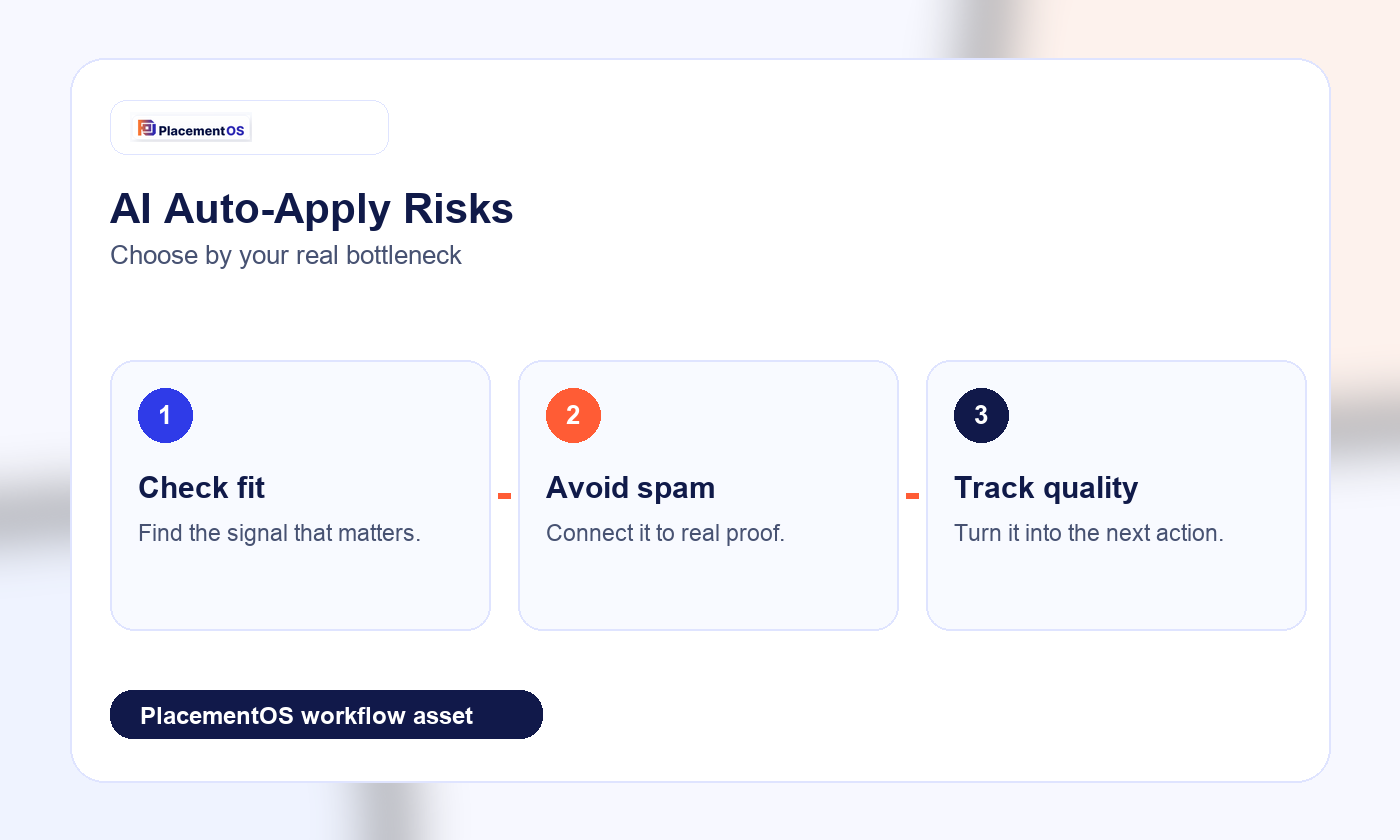
AI auto-apply can save time on repetitive applications, but the risk is low-fit volume. Use automation to find roles, draft responses, and fill stable fields; keep human review for fit, claims, screening questions, and final submissions.
Quick comparison
| Question | Best answer | PlacementOS angle |
|---|---|---|
| Primary problem | AI auto apply risks | Connect the point solution to weekly execution. |
| Risk to avoid | Unreviewed automation, keyword stuffing, or scattered tracking. | Keep human review and outcome review in the loop. |
| Best next action | Choose the tool by bottleneck, not hype. | Target, tailor, apply, follow up, and learn weekly. |
Why auto-apply is attractive
The modern job search is repetitive. Tools now find jobs, tailor resumes, draft answers, autofill applications, and in some cases submit on the candidate's behalf. The appeal is obvious: less manual form work and more reach.
The core risk
More applications are not automatically better applications. High-volume automation can send weak matches, reuse stale answers, miss role-specific context, and reduce the candidate's ability to learn from the market. It can also create trust issues if claims are not reviewed.
How competitors frame automation
Jobscan's Auto Apply emphasizes matched jobs, tailored application drafts, and review before submission. LoopCV leans further into auto-applying to many matching jobs. Simplify and Huntr focus more on autofill and tracking. PlacementOS should own the quality-first operating model.
A safer automation policy
Let AI handle discovery, deduplication, stable-profile autofill, first-draft answers, and tracker updates. Keep manual review for role selection, resume version choice, screening answers, salary expectations, cover notes, and final submit decisions.
The weekly review loop
Every Friday, review response rate, role fit, resume variants, outreach, and interview conversion. If automation increases submissions but lowers response quality, reduce volume and improve targeting. The goal is better signal, not just more sends.
What to automate first
Start with low-risk automation: deduplicating roles, extracting job requirements, saving links, organizing deadlines, and drafting first-pass notes. Delay high-risk automation, such as final submissions or screening-question answers, until the workflow proves it is preserving accuracy and improving response quality.
Example automation policy
A practical rule is to let AI prepare, but not decide. Let it find roles, summarize requirements, draft answers, and prefill stable information. Then the candidate reviews whether the job fits, whether the resume version is honest, whether the answer sounds human, and whether the application is worth sending.
Best fit and poor fit
Auto-apply is a strong fit for repetitive workflows where the candidate has clear targeting and reviewed materials. It is a poor fit for career pivots, senior roles, nuanced applications, or any situation where the candidate needs to explain context rather than simply submit more forms.
Decision rule
Choose the tool only after naming the bottleneck. If the bottleneck is speed, improve the repetitive steps. If the bottleneck is fit, improve targeting and proof. If the bottleneck is follow-up, improve the tracker. If the bottleneck is uncertainty, use a weekly review before adding more applications.
This is the PlacementOS rule for the whole cluster: tools are useful when they make the next action clearer. They are risky when they create more activity without better decisions, stronger evidence, or cleaner follow-through.
Related PlacementOS guides
- AI job-search tools comparison hub
- Best AI job search tools for a 7-day sprint
- Interview copilot risks and safer AI prep
FAQ
Is AI auto-apply bad?
Not always. It can help with repetitive work, but it becomes risky when it submits low-fit applications or unreviewed claims.
Do auto-apply tools submit without review?
Some tools emphasize review before submission, while others promote more autonomous application volume. Always check the workflow and keep control over final submissions.
How many jobs should I apply to with AI?
There is no universal number. Track response quality. If volume rises but callbacks fall, prioritize fit and tailoring over more applications.
Sources
- Jobscan Auto Apply
- LoopCV official site
- LoopCV auto-apply
- LoopCV AI job application agent
- Simplify Copilot
- Careerflow browser extension
Use PlacementOS when you want the whole search organized into a weekly operating loop instead of another disconnected tool decision.