The best AI cover letter generator is the one that helps you create a role-specific draft, then review it for truth, tone, proof, and fit before sending. Use AI for speed, but keep human quality control over every claim and example.
Quick comparison
| Question | Best answer | PlacementOS angle |
|---|---|---|
| Primary intent | best AI cover letter generator | Turn the topic into proof, review, and next action. |
| Main risk | Using AI or keywords to create generic, unsupported material. | Keep truth, role fit, and human review in the loop. |
| Best next action | Name the bottleneck before choosing the tool or edit. | Target, tailor, practice, apply, follow up, and learn weekly. |
Why cover letter tools are back in the workflow
Cover letters can still matter when a role asks for motivation, career-change context, portfolio explanation, relocation context, or a concise case for fit. AI generators help because they remove the blank-page problem and translate a job description into a draft structure. The risk is that a fast draft can sound generic, overconfident, or disconnected from the resume. PlacementOS should treat the cover letter as part of an application packet, not as a standalone writing exercise.
What to compare in AI cover letter generators
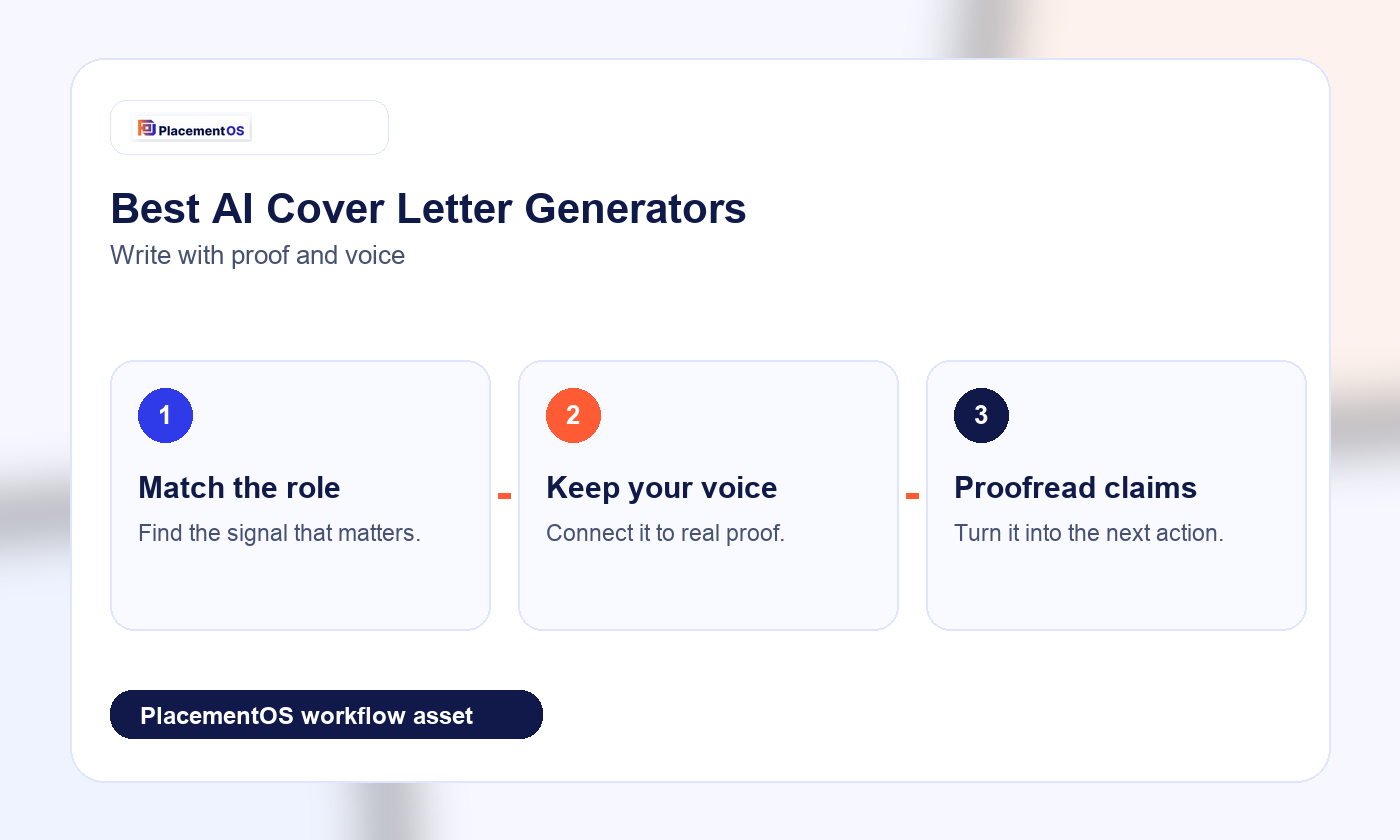
Compare tools on five practical dimensions: how much job context they accept, whether they preserve candidate voice, whether they connect to resume proof, how easy revision is, and whether the final letter can be reviewed before sending. A tool that creates a polished paragraph is useful. A workflow that catches weak claims, mismatched tone, and missing proof is more useful for serious applications.
Quality-control table
Use a simple review table before sending. Role fit asks whether the opening names the right problem. Proof fit asks whether the letter points to specific work from the resume. Tone fit asks whether the message sounds like a professional human, not a template. Accuracy asks whether every claim is true. Next action asks whether the letter supports a reviewed application, not a blind submission.
How PlacementOS should handle cover letters
PlacementOS can own the layer after generation. Save the target role, compare requirements to resume evidence, draft the letter, flag unsupported claims, and attach the final version to the application record. That makes the cover letter part of the same operating loop as resume tailoring, follow-up, and weekly review.
Where dedicated tools can help
Specialized tools often focus on speed, personalization, templates, or resume and job-description matching. Those features are useful when the candidate still reviews the output. A cover letter generator should not decide what is true. It should help structure the case, suggest stronger phrasing, and make revision easier.
A safe prompt pattern
Start with the job title, company context, three relevant proof points, one reason for interest, and tone constraints. Ask for a short draft that does not invent metrics, tools, employers, awards, credentials, or outcomes. Then revise with a checklist: shorten the opening, strengthen one proof point, remove generic adjectives, and align the close with the role.
Decision rule
Use a cover letter generator when it saves drafting time and improves clarity. Use PlacementOS when you need the draft tied to role fit, resume proof, application tracking, and follow-up. If the letter cannot be supported by your actual experience, rewrite it or skip that angle.
Decision rule
Choose the workflow by bottleneck. If writing is slow, use AI to draft. If proof is weak, improve the resume. If interview answers are scattered, practice before the real round. If applications are hard to manage, connect every asset to one weekly operating loop.
PlacementOS belongs where candidates need quality control across the whole search, not another disconnected draft, score, or tool choice.
Related PlacementOS guides
- Tailor a resume without sounding generic
- Best AI resume tailoring tools
- AI auto-apply risks
- LinkedIn AI job-search workflow
FAQ
What makes an AI cover letter generator useful?
It is useful when it turns job context and resume proof into a specific draft that the candidate can review, revise, and send confidently.
Should I let AI write the whole cover letter?
AI can create the first draft, but the candidate should review every claim, example, and tone choice before sending.
How do I avoid a generic AI cover letter?
Provide role context, real proof points, constraints, and a preferred tone. Then remove vague praise and replace it with specific evidence.
Sources
- Wobo cover-letter generator comparison
- OphyAI cover-letter generator comparison
- Kickresume AI cover-letter generators
Use PlacementOS when the goal is a reviewed, role-specific job-search system instead of a faster way to produce disconnected assets.