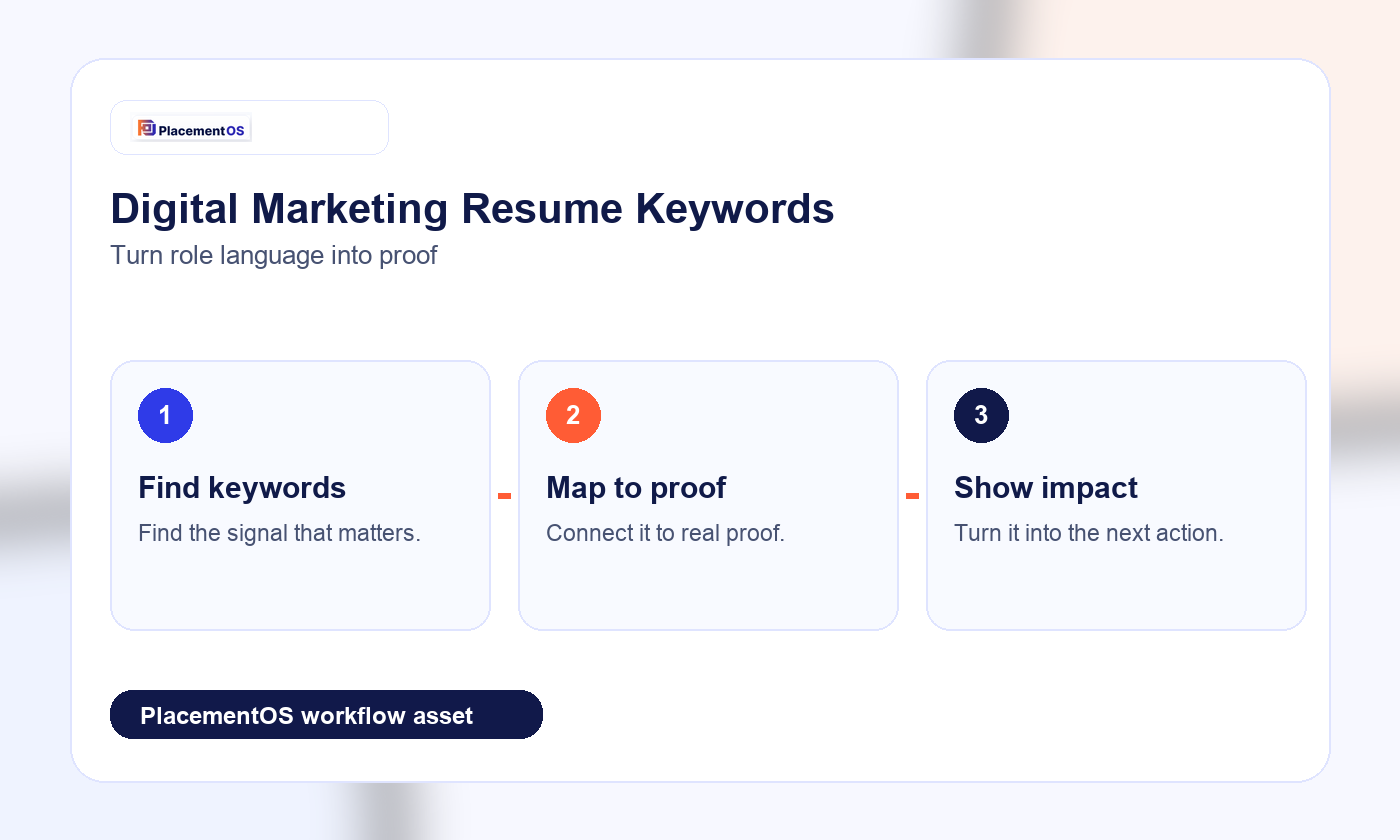
Digital marketing resume keywords should match the channel proof the job actually needs: SEO, paid media, analytics, content, lifecycle, email, CRO, attribution, and campaign performance. Use keywords inside results-oriented bullets with tools, metrics, and scope, then tailor the first third of the resume to the dominant channel.
Quick comparison
| Question | Best answer | PlacementOS angle |
|---|---|---|
| Primary intent | digital marketing resume keywords | Turn the topic into proof, review, and next action. |
| Main risk | Using AI or keywords to create generic, unsupported material. | Keep truth, role fit, and human review in the loop. |
| Best next action | Name the bottleneck before choosing the tool or edit. | Target, tailor, practice, apply, follow up, and learn weekly. |
Digital marketing keywords are not one lane
Digital marketing roles can mean very different work. One posting may focus on SEO and content. Another may need paid search, paid social, lifecycle email, analytics, CRO, or marketing operations. A strong resume does not pretend every marketer is equally deep in every channel. It shows the right channel proof for the role.
Keyword groups to separate
Build the resume around channel groups. SEO includes technical SEO, content briefs, search intent, internal linking, and ranking analysis. Paid media includes campaign structure, bidding, creative testing, CAC, ROAS, and budget management. Analytics includes GA4, dashboards, attribution, conversion rate, and cohort reporting. Lifecycle includes segmentation, email, automation, retention, and nurture flows.
Keyword-to-proof table
Every keyword needs a proof pattern. SEO should connect to pages, traffic, rankings, conversions, or technical fixes. Paid media should connect to spend, testing, CPA, ROAS, or lead quality. Content should connect to briefs, editorial cadence, organic demand, or assisted pipeline. CRO should connect to experiments, landing pages, conversion rate, and statistical caution.
How to tailor for specialization
Read the posting and identify the dominant lane before editing. If the role is performance marketing, lead with paid media metrics and analytics. If it is content marketing, lead with search intent, content systems, and pipeline contribution. If it is lifecycle, lead with segmentation, automation, retention, and CRM or ESP tools. The resume should make the specialization obvious in the first third.
Example bullet rewrite
Weak bullet: worked on digital campaigns and analytics. Stronger bullet: rebuilt paid-search campaign groups around high-intent terms, monitored GA4 conversion paths, and shifted budget toward landing pages with stronger qualified-lead rates. The stronger bullet uses keywords, but the real value is channel-specific proof.
How PlacementOS should fit
PlacementOS can help marketers avoid generic keyword stuffing by matching a posting to the right channel evidence. It can identify required skills, map those skills to proof, flag missing metrics, save tailored versions, and track which specializations are generating interviews. That makes resume tailoring part of market learning.
Decision rule
Use digital marketing keywords only when they match real work. Lead with the channel the posting cares about most, support it with tools and metrics, and avoid claiming expertise across SEO, paid, lifecycle, analytics, and CRO unless your experience can back it up.
Decision rule
Choose the workflow by bottleneck. If writing is slow, use AI to draft. If proof is weak, improve the resume. If interview answers are scattered, practice before the real round. If applications are hard to manage, connect every asset to one weekly operating loop.
PlacementOS belongs where candidates need quality control across the whole search, not another disconnected draft, score, or tool choice.
Related PlacementOS guides
- Tailor a resume without sounding generic
- Resume score vs job match score
- Data analyst resume keywords
- LinkedIn AI job-search workflow
FAQ
What keywords should a digital marketing resume include?
Common groups include SEO, paid media, GA4, analytics, content strategy, email, lifecycle, CRO, attribution, campaign management, and performance reporting.
How do I tailor a digital marketing resume?
Identify the dominant channel in the posting, then move the strongest matching proof, tools, and metrics into the first third of the resume.
Should I list every marketing tool I have used?
No. Prioritize the tools that match the posting and that you can explain with real projects, campaigns, or reporting responsibilities.
Sources
- BrainStation digital marketing resume guide
- Kickresume digital marketing resume guide
- Enhancv digital marketing resume guide
Use PlacementOS when the goal is a reviewed, role-specific job-search system instead of a faster way to produce disconnected assets.